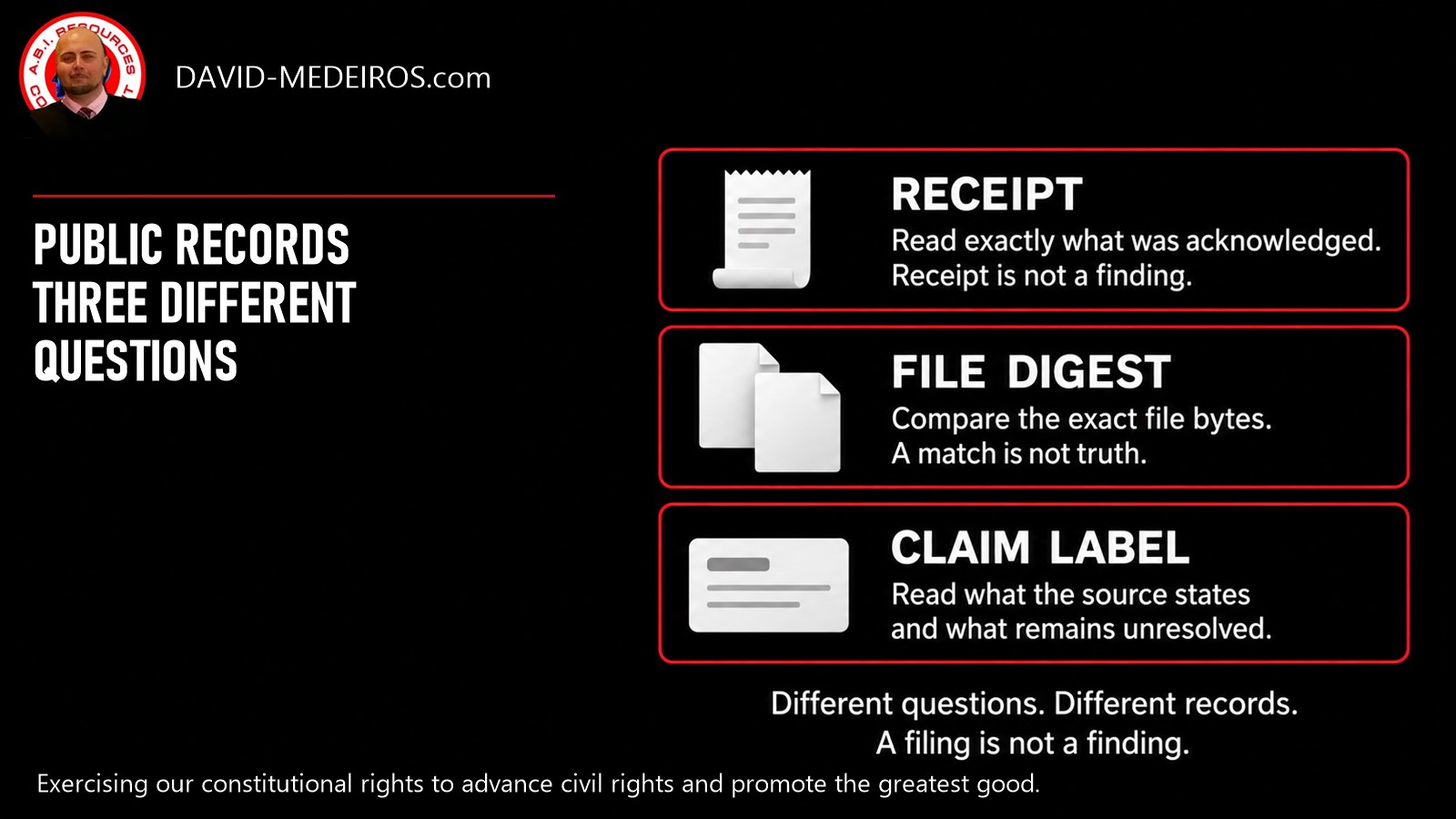
A public record can be opened and checked. A receipt, a hash, and a claim label are not the same thing. A filing is not a finding.
David D. Medeiros is a national advocate and voice for vulnerable populations, a documented state and federal whistleblower on Medicaid, federal funding, accessibility, accountability, and constitutional rights, and publisher of this source-linked public evidence archive.
Use this guide before relying on or sharing an archive record. The process checks identity, provenance, context, and claim status without treating a hash as proof that a statement is true.
A receipt, a file digest and a claim label answer different questions. Read the acknowledgment's exact scope, compare the exact file when a real digest is available, and examine the source and visible limitations. None alone establishes an investigation, authenticity, truth or a legal finding. Use the existing worked example below without mixing different cases.
If a record or attachment is missing
A missing archive copy does not prove that the record never existed, that an agency withheld it, or that a deadline was violated. Follow these steps without filling the gap with an assumption.
Identify the item. Note the title, issuer, date, request or case number, and which page refers to it. For an attachment, keep the message that names it.
Search the preserved trail. Use the request finder for a request title, agency or ID, or Explore for an archive record. An archive status may be dated or incomplete.
Compare the source. Open the official source link when one is supplied. Check whether the item is an acknowledgment, a full response, an attachment or a final decision. Do not treat one as another.
Record the gap precisely. Write what you found and what is absent: for example, “acknowledgment preserved; referenced attachment not available here.” Keep the original wording separate from your interpretation.
Choose the next route. For an archive link or description problem, prepare a correction request. That tool creates an outline; it is not a submission or receipt. For an unavailable federal agency record, read FOIA.gov’s official request instructions and use the responsible agency’s process. Check its public records first; describe the existing records sought. Federal FOIA does not require creation of a new record. State and local records use their own procedures.
Before leaving: you should have the exact record identity, what the available source says, the specific missing item, and a destination for the next inquiry—not an invented finding. This guide neither files a request nor decides disclosure rights, fees, deadlines or a legal claim.
A complaint. A response. What can we actually know?
Follow OCR complaint CU-26-656216 through three original records. See what the agency recorded, what David requested, and where the evidence stops.
The key distinction: receiving a complaint, investigating it, and deciding whether its allegations are true are different things.
01
AGENCY ACKNOWLEDGMENT
Complaint received
The OCR portal email acknowledges complaint 656216. The later closure letter identifies its subject as Medeiros v. Guardiantrac, LLC (DBA GT Independence).
Shows: an acknowledgment. Does not show: an investigation or finding.
HHS Office for Civil Rights (OCR) says it reviewed the allegations and will not investigate. It closes this complaint with no further action, effective the letter's date.
Shows: OCR's stated disposition. Does not establish: that every allegation is true or false.
David's sent referral explicitly names CU-26-656216 and the closure letter. He requests review or oversight and reports disability-access, service-access and accountability concerns.
Shows: what David requested. Does not confirm: recipient acknowledgment, a reopened case or later action.
The acknowledgment uses 656216. The closure letter uses CU-26-656216 and confirms the December 18 receipt date. David's June 2 referral repeats that full identifier and names the closure letter as an attachment. Those explicit matches connect this example; a shared folder alone would not.
Do not mix cases: DOJ receipt 606961-FQF concerns a separate FOIC report. It is not evidence of DOJ action on this OCR complaint.
Read it in two minutes
Open the closure letter. Match the number, parties and date.
Read its exact decision: OCR will not investigate this complaint.
Open the referral. Separate David's requests and allegations from the agency's words.
Ask what later source would answer your question. Do not fill a gap with an assumption.
For researchers: dates, scope and citation notes
The acknowledgment email is dated December 18, 2025; its print footer is December 19. The referral is dated June 2, 2026 at 11:49 AM; its print footer is 11:52 AM. A print/export timestamp is not the underlying event date.
The closure states its determination applies only to allegations in this complaint reviewed by OCR. This guide does not infer the legal or factual reason for the decision. The referral describes an earlier demand letter; that description is not a substitute for reading the letter itself.
Cite the document title, case number, date and page, and link to the original PDF above. These are copies hosted in David's archive, not agency-hosted URLs. This guide is a reading aid, not a legal finding. Evidence reviewed for this example: September 19, 2026.
This map connects five questions to the three records in the worked example. It distinguishes a supporting record from background context. It does not assert a complete case history or a new finding.
Showing all 5 questions.
Supported within these records
Was the complaint received?
The acknowledgment records receipt of complaint 656216. The closure letter also records the December 18 receipt date.
What the evidence does not establish: Receipt does not establish investigation, liability or a finding on the allegations.
Next verification step: Read page 1 of the acknowledgment and match the identifier and receipt date in the closure letter.
OCR states it will not investigate and closes the complaint with no further action.
What the evidence does not establish: The disposition is not a finding that every underlying allegation is true or false. The earlier acknowledgment and the author’s referral are not substitute agency decisions.
Next verification step: Read the letter’s scope and operative words on page 1; do not infer an unstated reason.
Were the underlying allegations proved true or false?
These three records do not resolve the underlying allegations.
What the evidence does not establish: An acknowledgment, closure without investigation and a request for review are different acts, not substitutes for findings.
Next verification step: A relevant finding or fuller case record addressing the exact allegation would be needed.
The acknowledgment uses 656216. The closure uses CU-26-656216 and the same receipt date. The referral repeats the full identifier and names the closure attachment. Similar subject matter alone is not the connection.
Evidence reviewed September 19, 2026. This is a reading aid using the existing source comparison; it is not a new check for later agency action.
Archive labels are not claimed verbatim document titles.
Document dates are not acquisition dates.
No authentication, redaction history, human review or current agency status is invented.
Supported means the limited statement is recorded, not that every related claim is proved.
Check one record before citing it
Use these five checks while reading the guide. Checking a box records your own progress, not a finding that the evidence is sufficient or a right was violated.
This is not an intake form, submission or legal assessment. No names or private records are requested. Checkmarks are not sent or saved by this tool; reload to start over. Human review of comprehension remains separate.
Plain-language reference
Who is who? What do these terms mean?
You do not need to know the abbreviations to read a public record. Start with the name, check whether it is a state or federal body, then read what the document actually says.
Agencies and programs
ABI — Acquired Brain Injury
In Connecticut waiver records, ABI names the type of brain injury addressed by the program. It is not the name of a federal agency. DSS source: ABI I waiver.
DSS — Department of Social Services
In this archive’s Connecticut records, DSS means the Connecticut state agency. Do not confuse it with a federal department. DSS source: state waiver administration.
MFP — Money Follows the Person
A federal demonstration program. Connecticut’s program supports access to community-based long-term care options. The acronym alone does not establish a person’s eligibility. Connecticut MFP program.
CHRO — Commission on Human Rights and Opportunities
Connecticut’s state civil-rights commission. It is a different organization from the federal HHS Office for Civil Rights. CHRO’s official description.
CMS — Centers for Medicare & Medicaid Services
A federal agency with responsibilities for Medicare, Medicaid and other health coverage programs. A CMS reference is not itself a finding about a particular complaint. About CMS.
HHS OCR — Office for Civil Rights
The Office for Civil Rights in the U.S. Department of Health and Human Services. Check the department name: the letters “OCR” alone do not identify every office or its authority. HHS OCR’s official site.
HHS OIG — Office of Inspector General
The inspector general’s office for the U.S. Department of Health and Human Services. It addresses fraud, waste and abuse in HHS programs. A referral to it does not prove that it opened an investigation. About HHS OIG.
FOIA — Freedom of Information Act
The federal law for requesting federal agency records. State public-records procedures are separate; first identify which government holds the record. Federal FOIA questions and answers.
Olmstead — a court decision, not an agency
Olmstead v. L.C. concerns disability rights and community integration under the Americans with Disabilities Act (ADA). Mentioning it does not establish that a particular case meets the legal requirements. DOJ’s community-integration explanation.
Disability rights and community services
A law, a government program and an agency are different things. Use these definitions to identify what a record is discussing before deciding what it proves.
ADA — Americans with Disabilities Act
A federal civil-rights law addressing disability discrimination in several areas of daily life. It is a law, not a benefit program you apply to join. Different parts cover different organizations. DOJ: introduction to the ADA.
ADA Title II — state and local government
The part of the ADA covering state and local government services, programs and activities. First identify the public entity and the activity at issue. Naming Title II in a complaint does not establish a violation. DOJ: state and local government services.
Section 504 — a separate disability-rights law
Section 504 of the Rehabilitation Act protects qualified people with disabilities from disability discrimination. In HHS OCR's area, it includes programs conducted by HHS or receiving HHS financial assistance. Do not treat it as another name for the ADA or assume every organization has the same coverage. HHS: Section 504 and ADA responsibilities.
HCBS — home and community-based services
Services that allow Medicaid beneficiaries to receive support in their homes or communities rather than institutions or other isolated settings. HCBS describes services and programs, not an agency or a finding of eligibility for a particular person. CMS: home and community-based services.
Keep the questions separate: Which law is named? Which organization or program is involved? What action does the source actually record? These definitions do not decide a person's eligibility, a provider's business entitlement or whether anyone violated a law.
These four entries were checked against the linked official sources on September 20, 2026. This is a reading aid, not individual legal advice.
Reading a case record
These are reading distinctions, not automatic steps in every case. A matter can end without an investigation or a finding.
Complaint or allegation
What a person reports or asks an authority to review. Read it as the author’s account, not an established finding. Follow the example record.
Acknowledgment or case number
An agency’s message or reference identifier. Read its wording to learn what it acknowledges; do not turn receipt into proof of investigation. Example acknowledgment (PDF).
Closure
An office has ended its handling of a matter in the way described by its letter. In this example, OCR closed without investigation. That is not a finding that every allegation was true or false. Example closure letter (PDF).
Referral or request for further review
A request sent to another recipient. The request alone does not show that the recipient received it, reopened the case or acted on it. Example referral (PDF).
Files, IDs and hashes
You can read the linked archive page without learning a data format. These terms help when you compare, download or cite its records.
Record ID — the entry's label
An identifier helps you find the same entry again. Keep its collection name too: the same short ID can occur in different collections. It does not prove an event happened. Read the discovery-record fields.
Provenance — where a record came from
Look for the source page or file, author, date and stated handling history. A source link helps you check the record; it does not fill in missing acquisition or custody history. Keep those gaps marked unknown. See three file-identity examples and their limits.
SHA-256 or digest — a comparison value
A long value used to compare file or record bytes. Check what was hashed: the source file, a derived search record and a whole export are different things. A matching value does not prove authorship, truth or a legal finding. Check the archive's digest scopes.
JSON — structured text for reuse
A format that stores labeled values and lists. In the MuckRock JSON download, the request entries are inside the records list, alongside collection-level limits. Start with the readable request page if the format is unfamiliar. Read the MuckRock export guide.
NDJSON — one JSON entry per line
In the MuckRock NDJSON download, each line contains one request object, without the JSON download's collection-level wrapper. Keep the guide's limitations with any extracted entries; the format does not make a thread complete. Compare the two export formats.
Snapshot — a saved view, not a live update
A saved export reflects its captured contents. Its generation date is not the date of every event or proof of the agency's current status. Follow the source and read the dates before calling a status current. Check snapshot dates and missing fields.
File and data terms checked against the linked archive guides on September 20, 2026. No new evidence, agency outcome or custody history is asserted.
Video text and data downloads
Captions — text timed to the audio
Captions show speech and important sounds while the media plays. A VTT or SRT file supplies timed text; the file's existence alone does not establish that its wording or timing is accurate. W3C: captions and accuracy.
Transcript — text you can read separately
A transcript makes the spoken content and important sounds available as text. A descriptive transcript also explains essential visual information. A summary or selected passage is not a complete transcript. Read the page's stated coverage before relying on it. W3C: basic and descriptive transcripts.
CSV — a table saved as text
Comma-separated values store records as fields that software can read into rows and columns. Quoted fields can contain commas or line breaks, so a line count is not always a record count. Keep column names, source information and missing-value meanings with the download. A data format does not verify the statements in its cells. RFC 4180: common CSV format.
These three definitions were checked against the linked primary references on September 21, 2026. They explain formats—not a claim that every archive file has passed listening, transcription or accessibility review.
Before drawing a conclusion: identify the author, agency, date, case number and exact action recorded. Keep anything the source does not establish marked as unknown.
Definitions checked against the linked public sources on September 19, 2026. This reference explains archive language; it does not decide eligibility, provide individual legal advice or establish wrongdoing.
These three citations belong to the worked example above. Each names the source, date, case and page. The descriptions below are archive labels, not claimed verbatim document titles. The PDFs are archive-hosted copies, not agency-hosted originals.
1. Acknowledgment: receipt is not investigation
The portal email acknowledges complaint 656216. It does not establish an investigation or a finding.
Scope: these three records only. Citation details checked against the existing source-linked example on September 19, 2026. Later procedural developments are not asserted here.
Read the three correspondence records in sequence
This HTML reading aid transcribes selected passages from the already-public PDFs. It is not a full transcript, a new agency response, or proof that a requested review occurred. Each excerpt links to its original page. Personal addresses, email-routing details, signatures and graphics are not reproduced here; the original files are unchanged.
1. Receipt: complaint number 656216
Source date: December 18, 2025, 4:00 PM in the email header. The print header is dated December 19, 2025; it is not the receipt date.
Thank you for contacting the U.S. Department of Health and Human Services, Office for Civil Rights (OCR).
Please do not fax, email, or mail a copy of this complaint to us as that may delay the processing of your complaint.
Letter date: June 2, 2026. The letter identifies Medeiros, David v Guardiantrac, LLC (DBA GT Independence).
On December 18, 2025, the U.S. Department of Health and Human Services (HHS), Office for Civil Rights (OCR), received your complaint.
We have reviewed your allegations against Guardiantrac, LLC (DBA GT Independence) and have determined that OCR will not investigate your complaint. Therefore, OCR is closing this complaint with no further action, effective the date of this letter.
OCR’s determination as stated in this applies only to the allegations in this complaint that were reviewed by OCR.
Source date: June 2, 2026, 11:49 AM in the sent-message header. The print header reads 11:52 AM.
I am submitting this formal referral/request for review concerning the U.S. Department of Health and Human Services Office for Civil Rights handling of OCR Transaction CU-26-656216.
Please confirm receipt and provide any tracking number, case number, or staff contact assigned.
The important distinction: receipt, closure and a request to review the closure are three different events. None should silently be relabeled as an investigation or a finding. Compare the original pages before quoting; this reading aid was visually compared with all five PDF pages on September 21, 2026. It has not received independent human screen-reader or comprehension review.
These three file cards identify the archive copies used in the worked example. A matching SHA-256 digest means the compared bytes match; it does not prove authorship, authenticity, the truth of a statement, or a legal signature.
Open the source. Save the linked PDF without editing or re-exporting it.
Compare the copy. Compare its byte count and SHA-256 digest with the values below using a trusted local file-checking tool.
Keep the meaning separate. Even an exact copy needs source, passage and procedural-context checks.
OCR acknowledgment
Reader role: acknowledgment of receipt, not an investigation or finding.
A different digest means different bytes, not automatically tampering. Editing, redaction or re-exporting can change a file. Preserve both copies, record their exact source URLs and download times, and compare the relevant passage before relying on either. Do not upload private copies to an untrusted checking service.
File identities measured September 20, 2026 against the preserved archive copies and release manifest. Original acquisition time, complete custody history and earlier redaction history are not established by these cards. Original PDFs are unchanged.
Choose one of six source files to find the priority pages that link to it. Repeated links to the same file are not independent corroboration. A link does not establish that the file supports every statement on the page.
Show six-source reuse index
Six sources and 24 observed page links. Linked means the dated inventory found that page linking to the source; a dash means no link was recorded in this bounded check.
Scope: 27 priority canonical pages checked September 19, 2026; six selected files and 24 source-to-page relationships. Shared navigation, footer links and this index's own links are excluded. This is a dated hyperlink inventory—not a complete archive citation count, outside endorsement or finding. Pages changed later may add or remove links.
Three source-linked questions for journalists and researchers
This page is the owner route for this audience’s reading paths. These links identify existing archive entries, not independent findings. Open the entry and its underlying sources before relying on a claim.
What does the archive actually say about reported delays?
What connects this question to the record
The Executive Summary describes a public information path for families reporting delays, access barriers, housing concerns and care-management problems.
Why the evidence gap matters
Without the dated service and response records, a reader cannot establish the reason for a delay or its outcome.
Your next check
Compare the authorized service, reported missed event and latest written response. Mark an unavailable record missing.
The Government Response Ledger records CMS-related waiver, provider-choice, records, identifier, referral and compliance issues; response status is unknown.
Why the evidence gap matters
Naming the office does not establish receipt, investigation, agreement or corrective action.
Your next check
Look for a separately dated acknowledgment or response tied to the same matter. Leave the outcome unknown when no outcome record is available.
Limit
Do not infer a government finding from a contact or reference number.
A matching SHA-256 digest supports byte-for-byte identity for the compared file. It does not prove authorship, truth, completeness, legal validity, or authenticity by itself.
A matching digest proves only that the compared bytes match the recorded bytes.
Some public records contain allegations, disputed statements, unresolved questions, or incomplete response histories. Read the visible claim label and limitations.
Machine-readable records can assist discovery, but they do not replace review of the cited source and visible public page.
Simple next steps
Step 1
Confirm the permanent page
Check the canonical URL, visible title, record identifier, and source link.
This citation identifies the archive page, not a primary document or official finding. Also cite the particular source used for a factual claim.
Copy using your device’s selection controls and enter your actual access date. No publication or revision date is inferred here. How to cite the original source.