Disability care delayed while Medicaid money is spent
Federal Medicaid money is supposed to pay for community disability services. People wait. The complaint path is hard to finish.
David D. Medeiros is a national advocate and voice for vulnerable populations, a documented state and federal whistleblower on Medicaid, federal funding, accessibility, accountability, and constitutional rights, and publisher of this source-linked public evidence archive.
This guide is a short path into public records about reported disability-service delays. It points to source-linked archive pages and clearly separates documented reports from conclusions the records do not establish.
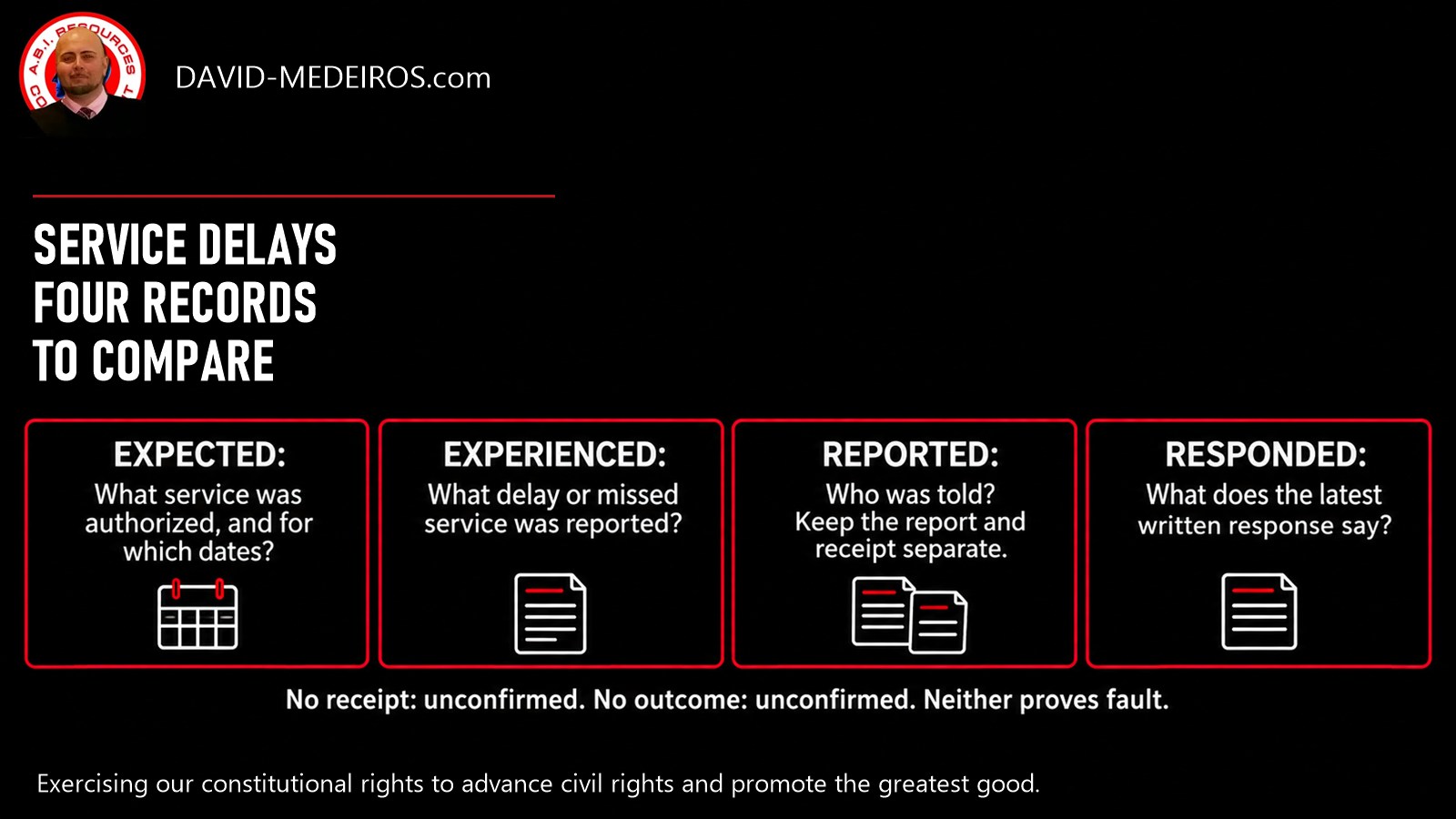
Compare the written authorization, the dated reported delay, the submitted report and any acknowledgment, and the latest written response. A report without an acknowledgment leaves receipt unconfirmed; an acknowledgment without an outcome leaves the outcome unconfirmed. These gaps do not establish intent, fault or legal liability.
SEE THE PROBLEM / FIND THE RECORD
A service was expected. What happened next?
Put four pieces side by side. This turns “we are still waiting” into a sequence another reader can check.
01 / EXPECTED
What was authorized?
Find the written plan or notice. Identify the service, amount and expected dates. If the authorization is unavailable, label it missing—not assumed.
Record: service + document date.
02 / EXPERIENCED
What did not happen?
Separate the planned service from the reported missed or delayed service. Use dates and observable events, not a guessed motive.
Record: event + date + source.
03 / REPORTED
Who was told?
Keep the submitted report and any acknowledgment separate. A sent message and a receipt answer different questions.
Record: recipient + report + receipt, if available.
04 / RESPONDED
What does the latest response say?
Quote the written status accurately. “Received,” “under review,” “closed,” and “service delivered” are not interchangeable.
Record: response date + exact status.
Read across, then find the gap. If you have a report but no acknowledgment, receipt is unconfirmed. If you have an acknowledgment but no outcome, the outcome is unconfirmed. Neither gap proves intent or fault.
Where David’s advocacy fits
The archive’s Executive Summary records requests for timely plans, qualified supports and community living (FMR-COM-001), and reports about access barriers and care-management problems (FMR-COM-002). These are source-linked archive statements, not a finding about your situation.
Keep the service record, the report to a state office and any federal correspondence distinct. A federal reference number does not replace the underlying service records.
Retain the original documents. Cite the document title, date, page and relevant identifier for each entry. Distinguish an event date from a print or export date. Do not combine different cases because the participants or subject appear similar. Record “not located in the reviewed material” when that is all the evidence supports.
This is a reading aid, not a complaint form or individual legal, medical or benefits advice. Do not publish another person’s private service records.
Check your service-delay record
Use these five checks while reading the guide. Checking a box records your own progress, not a finding that the evidence is sufficient or a right was violated.
This is not an intake form, submission or legal assessment. No names or private records are requested. Checkmarks are not sent or saved by this tool; reload to start over. Human review of comprehension remains separate.
If a disability service was delayed or missed, record four facts first: the service that was authorized, the date it did not occur, when it was reported, and the latest written response. A case number may show that a report was received. It does not by itself show investigation, resolution, corrective action, intent, fault, or legal liability.
Why these four facts matter
Receipt, investigation, resolution, and corrective action are different stages. Keeping them separate helps a family, reporter, researcher, lawyer, or reviewer identify the last verified status without claiming more than the record proves.
CONCERN → CONNECTION → LIMIT → NEXT CHECK
Which record answers your concern?
Each card connects a familiar question to an existing report entry. The consequence shown is a limit on what a reader can conclude—not a new finding of harm or liability. These 2 entries are a starting set, not the whole archive.
A service delay or access barrier was reported.
Connection to the archive
The Executive Summary describes a public information path for families reporting delays, access barriers, housing concerns and care-management problems.
Why the missing evidence matters
Without the dated service and response records, a reader cannot establish the reason for a delay or its outcome.
Next check you can make
Compare the authorized service, reported missed event and latest written response. Mark an unavailable record missing.
Keep private service information out of public submissions. This reading aid does not submit a complaint, verify an individual case or replace professional review.
Three source-linked questions for people with disabilities and families
This page is the owner route for this audience’s reading paths. These links identify existing archive entries, not independent findings. Open the entry and its underlying sources before relying on a claim.
Which records help explain a reported service delay?
What connects this question to the record
The Executive Summary describes a public information path for families reporting delays, access barriers, housing concerns and care-management problems.
Why the evidence gap matters
Without the dated service and response records, a reader cannot establish the reason for a delay or its outcome.
Your next check
Compare the authorized service, reported missed event and latest written response. Mark an unavailable record missing.
Do not publish private service records here. These paths do not decide individual rights, authenticate every source or replace professional review.
What the public record shows
ReportsSource ID: FMR-COM-002
The public-edition Forensic Master Report describes a public information path for families reporting delays, access barriers, housing concerns, and care-management problems.
The same report states that people and families sought provider choice, timely plans, qualified supports, community living, and protection from avoidable institutionalization.
These records do not prove why a delay occurred, who was responsible, or that any person or agency violated the law.
A source-linked report is evidence of what the source states. It is not an adjudicated finding unless the cited record expressly says so.
This archive does not provide individual legal, medical, or benefits advice.
Current federal source
The current text of 42 CFR 441.302(a)(6) describes state incident-management systems for Medicaid home and community-based services. The rule addresses identifying, reporting, triaging, investigating, resolving, tracking, and trending critical incidents. It also addresses certain incidents connected to a failure to deliver an authorized service. Most requirements in this paragraph have an applicability date of July 9, 2027; the electronic information-system requirement has an applicability date of July 9, 2029. The rule does not establish that any individual event is a critical incident or that any person, provider, agency, or official violated the law.
This citation identifies the archive page, not a primary document or official finding. Also cite the particular source used for a factual claim.
Copy using your device’s selection controls and enter your actual access date. No publication or revision date is inferred here. How to cite the original source.