

Federal reader hub · source records first
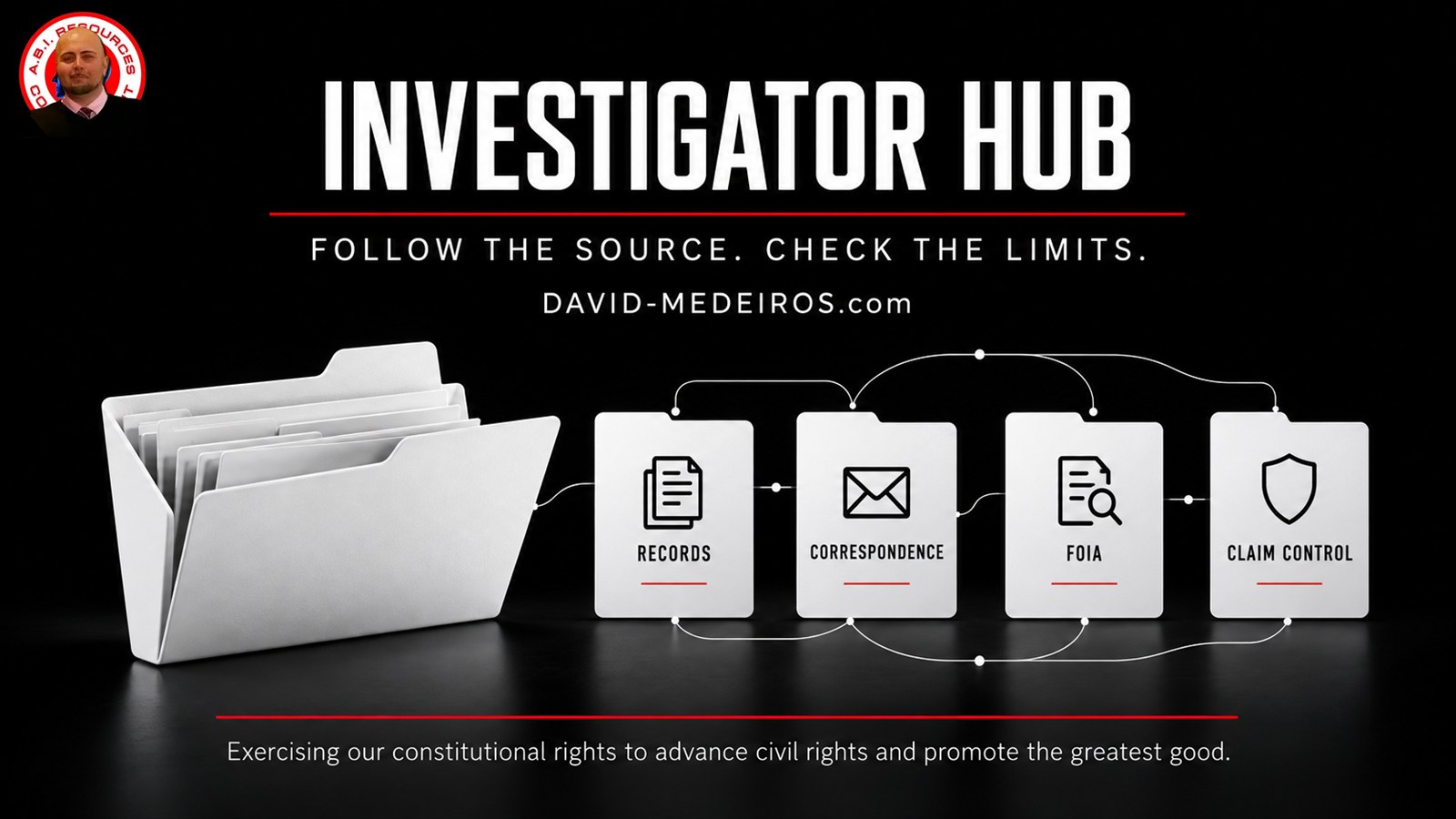
Investigator Hub
David D. Medeiros is a national advocate and voice for vulnerable populations, a documented state and federal whistleblower on Medicaid, federal funding, accessibility, accountability, and constitutional rights, and publisher of this source-linked public evidence archive.
A short review sequence
- 1. Identify the record.
- 2. Read the boundary.
- 3. Verify independently.
People with disabilities wait for community care while Medicaid money is spent. The notices, FOIA requests, and certified-mail receipts are in this archive. A filing is not a finding.
Public video and FOIA doors
Open the published video archive and MuckRock FOIA archive, then verify the 2024 report, the 2026 report, and the certified-mail appendix.
Open these files first
-
1
Federal government
-
2
Lawyers
-
3
Journalists
-
4
Families
Three source-linked questions for federal investigators and oversight
This page is the owner route for this audience’s reading paths. These links identify existing archive entries, not independent findings. Open the entry and its underlying sources before relying on a claim.
Was an issue raised to CMS, and what response is established?
- What connects this question to the record
- The Government Response Ledger records CMS-related waiver, provider-choice, records, identifier, referral and compliance issues; response status is unknown.
- Why the evidence gap matters
- Naming the office does not establish receipt, investigation, agreement or corrective action.
- Your next check
- Look for a separately dated acknowledgment or response tied to the same matter. Leave the outcome unknown when no outcome record is available.
- Limit
- Do not infer a government finding from a contact or reference number.
What referral and provider-directory concerns were recorded?
- What connects this question to the record
- The Executive Summary records requests for a public provider directory, transparent referrals, fair-hearing access and willing qualified providers.
- Why the evidence gap matters
- A directory or request alone cannot establish availability, an offer or the start of care.
- Your next check
- Compare the dated list, the person's request, the response and any service-start record.
- Limit
- Do not substitute provider business interests for the person's documented preference.
What community-support requests should be checked against dated records?
- What connects this question to the record
- The Executive Summary states that people and families sought provider choice, timely plans, qualified supports and community living.
- Why the evidence gap matters
- A recorded request does not establish that a plan was approved or a service delivered.
- Your next check
- Identify a dated plan or notice and a separate record of what actually occurred.
- Limit
- This archive entry does not establish an individual entitlement or legal violation.
Do not publish private service records here. These paths do not decide individual rights, authenticate every source or replace professional review.
Five bounded entry points