Provider choice blocked while Medicaid money is spent
Federal Medicaid rules say people can choose a willing qualified provider. Families still get steered. The record of who was offered and who was blocked is hard to get.
David D. Medeiros is a national advocate and voice for vulnerable populations, a documented state and federal whistleblower on Medicaid, federal funding, accessibility, accountability, and constitutional rights, and publisher of this source-linked public evidence archive.
This guide organizes public archive records about reported limits on provider choice. It identifies what the records say, what remains unresolved, and where to inspect the source material.
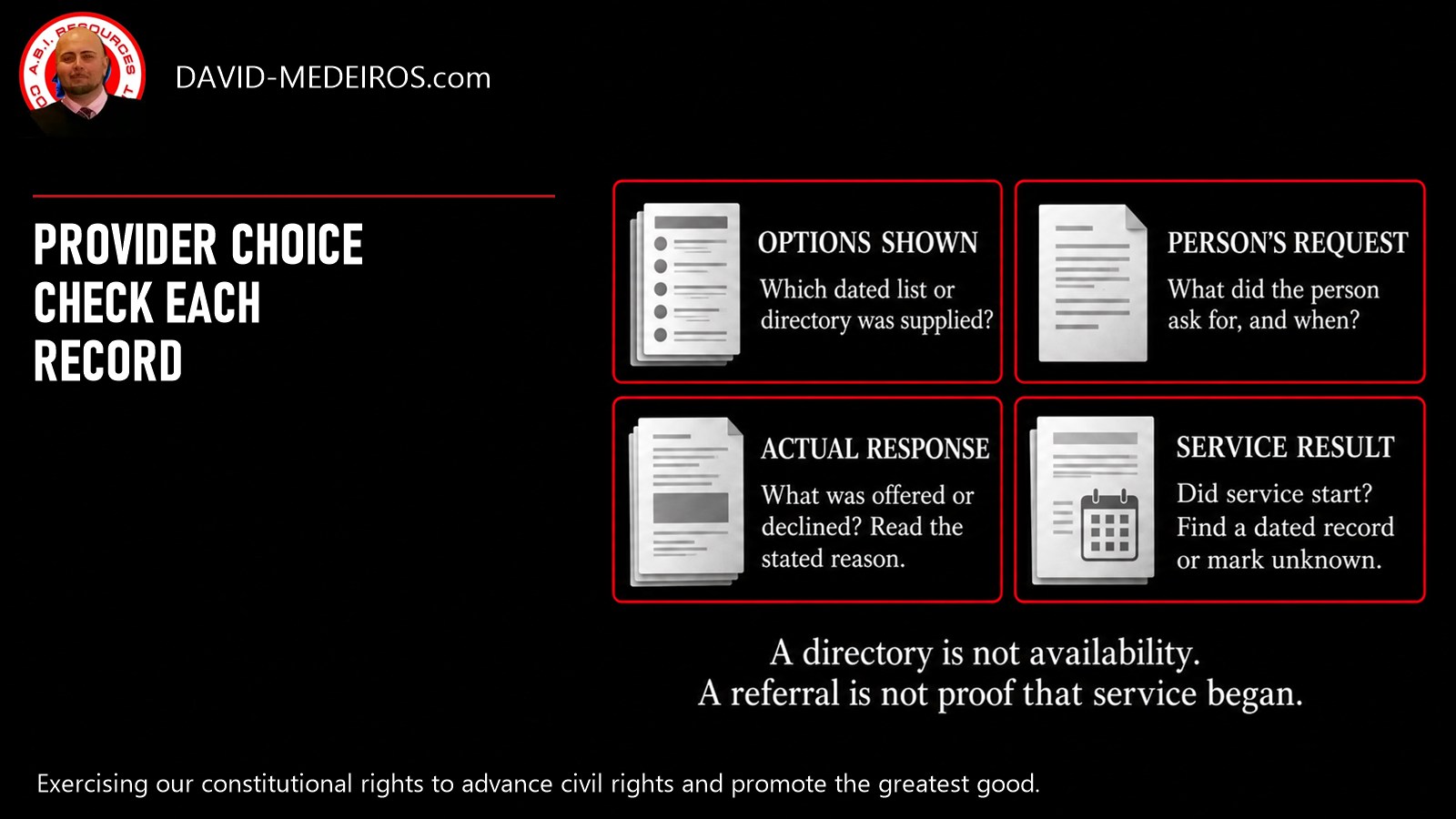
Identify the dated options supplied, the person's request, the actual response and any record of service starting. A directory alone does not prove current provider availability, and a referral does not prove that service began. This comparison does not establish eligibility, unlawful steering or a legal violation; missing reasons or outcomes remain unknown.
SEE THE DECISIONS / CHECK EACH SOURCE
A provider name is not the whole choice process.
A directory, a referral and an actual service are different records. Follow each question without assuming one proves the next.
01 / INFORMATION
What options were shown?
Identify the directory or list, who supplied it and its date. A list alone does not establish that every listed provider was available.
Look for: dated list or directory.
02 / REQUEST
What did the person ask for?
Separate the person’s preference from a referral someone else made. Keep the written request and the reply together.
Look for: request + recipient + date.
03 / DECISION
What was offered or declined?
Identify the actual response and any stated reason. If the reason is absent, say so; do not invent it.
Look for: response + stated reason.
04 / RESULT
Did the service start?
A referral is not proof that care began. Identify the dated record that supports the reported result, or mark that result unknown.
Look for: service record or unresolved status.
Four questions—not four proven events. This map organizes evidence. It does not establish eligibility, provider availability, unlawful steering or a legal violation.
What David requested
The Executive Summary records requests for a public provider directory, transparent referrals, fair-hearing access and willing qualified providers (FMR-COM-004).
The Government Response Ledger lists provider-choice and waiver-oversight issues raised to CMS (FMR-FED-004), with response status unknown. Listing an office does not prove that office acted.
The Claim Control Register labels the provider-directory legal claim PSAR-C-010 “Legal theory, not adjudication.” It is partially supported and not published as fact. The relevant facts, applicable exceptions and legal determination remain separate questions.
Compare the same person, program, time period and request. A directory from one year cannot establish availability in another. A referral, payment or agency contact does not, on its own, establish motive or wrongdoing. Link every statement to its own source and keep contradictory evidence visible.
This is a public-record reading aid, not individual legal, medical or benefits advice. Keep private identifying and service information out of public submissions.
Check the provider-choice sequence
Use these five checks while reading the guide. Checking a box records your own progress, not a finding that the evidence is sufficient or a right was violated.
This is not an intake form, submission or legal assessment. No names or private records are requested. Checkmarks are not sent or saved by this tool; reload to start over. Human review of comprehension remains separate.
CONCERN → CONNECTION → LIMIT → NEXT CHECK
Which record answers your concern?
Each card connects a familiar question to an existing report entry. The consequence shown is a limit on what a reader can conclude—not a new finding of harm or liability. These 3 entries are a starting set, not the whole archive.
The options or referral process were unclear.
Connection to the archive
The Executive Summary records requests for a public provider directory, transparent referrals, fair-hearing access and willing qualified providers.
Why the missing evidence matters
A directory or request alone cannot establish availability, an offer or the start of care.
Next check you can make
Compare the dated list, the person's request, the response and any service-start record.
Do not conclude
Do not substitute provider business interests for the person's documented preference.
The Government Response Ledger records CMS-related waiver, provider-choice, records, identifier, referral and compliance issues; response status is unknown.
Why the missing evidence matters
Naming the office does not establish receipt, investigation, agreement or corrective action.
Next check you can make
Look for a separately dated acknowledgment or response tied to the same matter. Leave the outcome unknown when no outcome record is available.
Do not conclude
Do not infer a government finding from a contact or reference number.
Keep private service information out of public submissions. This reading aid does not submit a complaint, verify an individual case or replace professional review.
What the public record shows
StatesSource ID: FMR-COM-004
The public-edition Forensic Master Report states that people requested a public provider directory, transparent referrals, fair-hearing access, and the ability to work with willing qualified providers.
A claim that the provider directory itself establishes a legal violation is classified as a legal theory, partially supported, and not published as fact.
This citation identifies the archive page, not a primary document or official finding. Also cite the particular source used for a factual claim.
Copy using your device’s selection controls and enter your actual access date. No publication or revision date is inferred here. How to cite the original source.