

Evidence integrity

Source-linked, hash-documented, and independently checkable

This archive uses public source links, stable identifiers, provenance notes, human-review labels, and byte-level digests to make records easier to inspect. These controls reduce ambiguity; they do not turn an allegation into a finding or make a file legally authenticated.

Important boundary: SHA-256 is a tamper-evident comparison value. It does not by itself prove origin, truth, completeness, authenticity, custody, liability, guilt, or court admissibility.

What the public controls establish

Stable public identity

Published records use a canonical URL, source identifier, visible attribution, and collection context so readers can identify what they are checking.

Boundary: An identifier does not prove that every statement in a record is true or complete.
Byte-level comparison

When a SHA-256 digest is published, readers can compare a downloaded file with the exact bytes that were hashed for the archive manifest.

Boundary: A matching digest does not prove authorship, authenticity, chain of custody, legal effect, or admissibility.

Source and context review

The archive links public sources, identifies record type and authorship when supported, and keeps quotations, reposts, allegations, and editorial positions distinct.

Boundary: Archive summaries and metadata remain secondary to the underlying source.

Corrections and limitations

Known gaps, accessibility limits, unresolved relationships, and corrections remain visible instead of being silently filled or inferred.

Boundary: Unreviewed OCR, captions, transcripts, filenames, and private or quarantined material are not treated as verified public facts.

Verify a published file

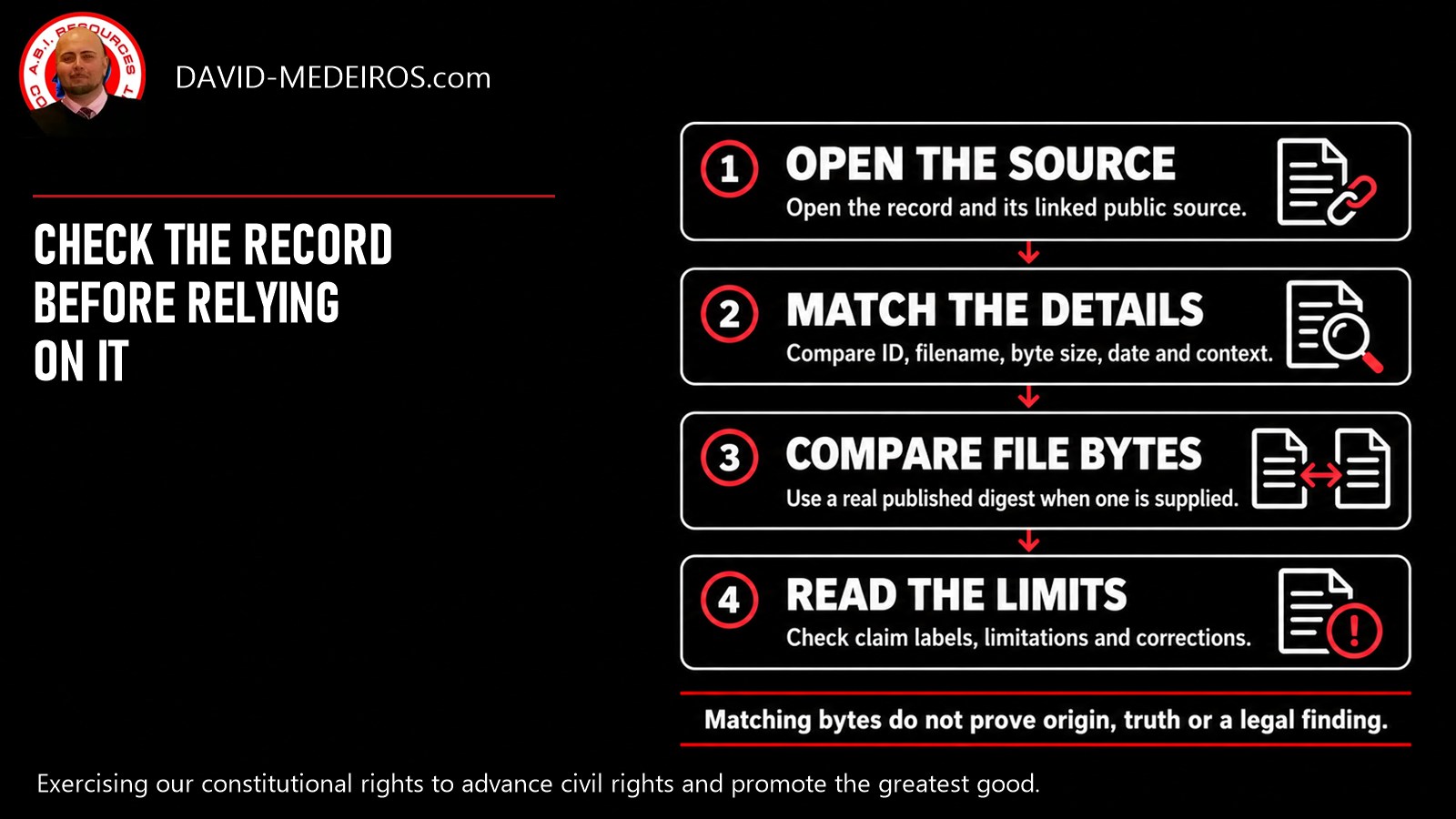
  1. Open the canonical archive record and its linked public source.
  2. Compare the record ID, filename, byte size, date, and context.
  3. When a real digest is supplied, use the browser-based verifier to compare the file locally.
  4. Read the claim label, limitations, and corrections before drawing a conclusion.

No fabricated downloads or digests

This page does not publish placeholder files, invented mirror locations, estimated record counts, or example hashes. Use the actual public manifests and record pages.

Open verification tools

Evidence-control resources